
Dogecoin Technical Analysis: Has DOGE Stopped Falling? This Key Support Level Holds the Answer

金色财经2025-12-09 tarihinde yayınlandı2025-12-09 tarihinde güncellendi

Özet

Based on technical analysis by Cantonese Cat, Dogecoin (DOGE) is currently testing a critical long-term support zone around $0.12–$0.14, defined by the lower edge of the monthly Ichimoku Cloud. Trading near $0.1405, DOGE is down approximately 3.8% for the month and remains below key Ichimoku components—the Conversion Line ($0.20092) and Base Line ($0.27491)—as well as below major moving averages on the weekly chart. The monthly close above this cloud support is crucial to maintaining the long-term bullish structure and avoiding a breakdown. On the weekly chart, DOGE is consolidating within a key support area of $0.135–$0.145, which aligns with historical consolidation levels. However, it has broken below an ascending trendline, with resistance now formed by this trendline and multiple moving averages, including the 200-week MA near $0.15563. The market is closely watching whether DOGE can hold this support to confirm a potential base formation.

According to charts shared by cryptocurrency analyst Cantonese Cat, Dogecoin (DOGE) is currently positioned above the long-term support band defined by its monthly Ichimoku Cloud. The analyst noted that DOGE is "testing the lower edge of its monthly Ichimoku Cloud."

Dogecoin Tests Key Monthly Cloud Support

The DOGE monthly chart shows the Dogecoin price at approximately $0.14050, down about 3.8% for the month. The monthly candlestick opened at $0.14599, reached a high of $0.15340, and probed a low of $0.13177, showing a pattern of volatility with a generally weaker bias.

Monthly Ichimoku Kinko Hyo Structure Analysis

The chart uses standard parameter settings (9-26-52-26). The current Conversion Line (Tenkan-sen) is near $0.20092, and the Base Line (Kijun-sen) is near $0.27491. The forward span of the Cloud (Kumo) is near $0.23792 and $0.26674, respectively, extending into 2026 and forming a red cloud band.

The current Dogecoin price of around $0.14 is significantly below both the Conversion and Base Lines and is currently within the region of the Cloud's lower edge. The bottom of this cloud, after descending into the $0.12–$0.13 range, is gradually flattening, becoming a key level watched by analysts.
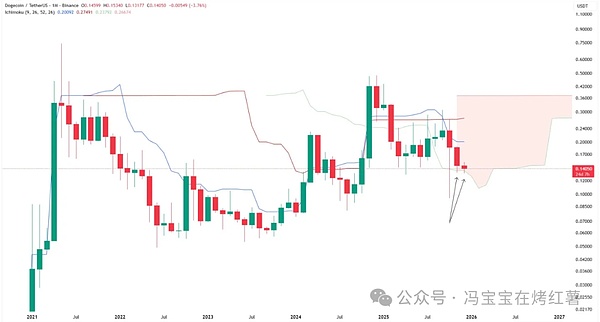
The October monthly candlestick had a long lower shadow, briefly dipping into the mid-$0.06 range but ultimately closing above the Cloud's lower edge. The currently forming monthly candlestick is testing this support again, with the price, at the time of the screenshot, slightly above this area, reported around $0.14.

In Ichimoku analysis, the Cloud's lower edge is often seen as the final support for maintaining structural integrity on higher timeframes. For the current chart, the implication is relatively clear: as long as the monthly close remains above the $0.12–$0.14 support zone, the price action of the past several years can still be interpreted as a long-term basing area, rather than a complete trend breakdown.

Weekly Chart Shows Price in Key Support Zone

On the DOGE/USDT weekly chart, the price is currently within a red support zone near $0.135–$0.145. This zone coincides with a previous consolidation range and was also a former horizontal resistance level before the prior upward breakout.

The closing prices of the most recent several weekly candlesticks have clustered here, with upper and lower shadows frequently piercing this area, reflecting repeated testing and contention. The current candlestick is trading near $0.14392, placing the price in the upper half of this support zone, but it remains below the 20-week, 50-week, 100-week, and 200-week moving averages, with the 200-week MA around $0.15563.
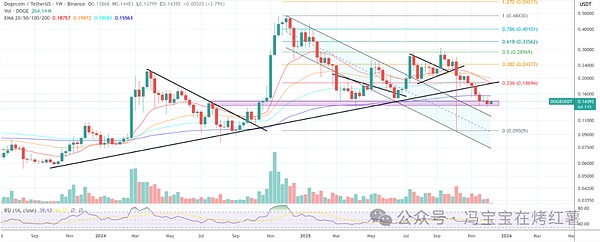
Meanwhile, Dogecoin has broken below the ascending trendline support connecting previous highs, followed by a significant pullback. Currently, this breached trendline, along with the multiple moving averages above, forms a resistance area, compressing the price between this resistance and the red horizontal support zone, resulting in a consolidation pattern.

İlgili Sorular

QWhat is the key support level for Dogecoin (DOGE) according to the monthly Ichimoku Cloud analysis?

AThe key support level is the lower edge of the monthly Ichimoku Cloud, which is in the $0.12–$0.14 range.

QWhat does it mean for DOGE's long-term trend if the monthly closing price remains above the $0.12–$0.14 support zone?

AIt would indicate that the long-term price structure remains intact as a bottoming area, rather than a complete trend breakdown.

QOn the weekly chart, what is the significance of the $0.135–$0.145 price region for DOGE?

AIt is a critical support zone that coincides with a historical consolidation range and was previously a horizontal resistance level before a breakout.

QWhere is DOGE's price currently trading relative to its major moving averages on the weekly chart?

AIt is trading below the 20-week, 50-week, 100-week, and 200-week moving averages, with the 200-week MA near $0.15563.

QWhat has happened to the ascending trendline that connected previous highs on the weekly chart?

ADOGE has broken below this ascending trendline support, which has led to a significant pullback in price.

İlgili Okumalar

Encryption Claims Dilemma: The Reality of Rights Protection Under the Conflict of Criminal and Civil Procedures

"Encrypted Claims Dilemma: The Reality of Rights Protection Amidst Criminal-Civil Procedure Conflicts" This article examines the challenges victims face in seeking legal recourse for cryptocurrency theft or fraud in China, highlighting the tension between criminal and civil procedures. Through two representative cases, it illustrates how cross-jurisdictional complexities and regulatory ambiguities often hinder effective relief. In Case 1, a South Korean company paid 800,000 USDT to a Chinese employee of an S-based exchange for listing services, only to have the employee disappear. Despite legal efforts citing属地管辖 (territorial jurisdiction) and the property-like status of virtual assets under China’s "9.24 Notice," local police initially refused to accept the case due to the foreign elements involved. After persistent advocacy, the case was accepted but not formally立案 (registered). Case 2 involved a woman scammed out of over 3 million RMB while attempting to purchase USDT through an OTC trader for investment. While the trader was arrested, the main fraudster remained abroad. Civil action against the trader for unjust enrichment failed, as courts cited the "criminal-first" principle (刑事优先), requiring criminal resolution before civil claims can proceed. The analysis reveals that civil remedies are often impractical when criminal elements are involved: courts may transfer such cases to police, and even successful criminal convictions may not guarantee restitution if perpetrators lack assets. The author concludes that, despite guides on civil litigation, pursuing criminal avenues remains the more viable—though still fraught—path for victims seeking recovery. The piece underscores systemic hurdles, including judicial reluctance to recognize crypto-related claims and procedural barriers, urging greater clarity in legal frameworks to protect victims.

比推2 dk önce

Encryption Claims Dilemma: The Reality of Rights Protection Under the Conflict of Criminal and Civil Procedures

比推2 dk önce

İşlemler

Spot
Futures
活动图片